There is a question worth asking about every part of your online business.
If the platform disappeared tomorrow, what would you have left?
For most people, the honest answer is: not much.
The illusion of ownership in online business
A social media following feels like an asset. You have built it, nurtured it, posted consistently for months or years. Ten thousand followers on Instagram. Twenty thousand on TikTok. A respectable number on Threads.
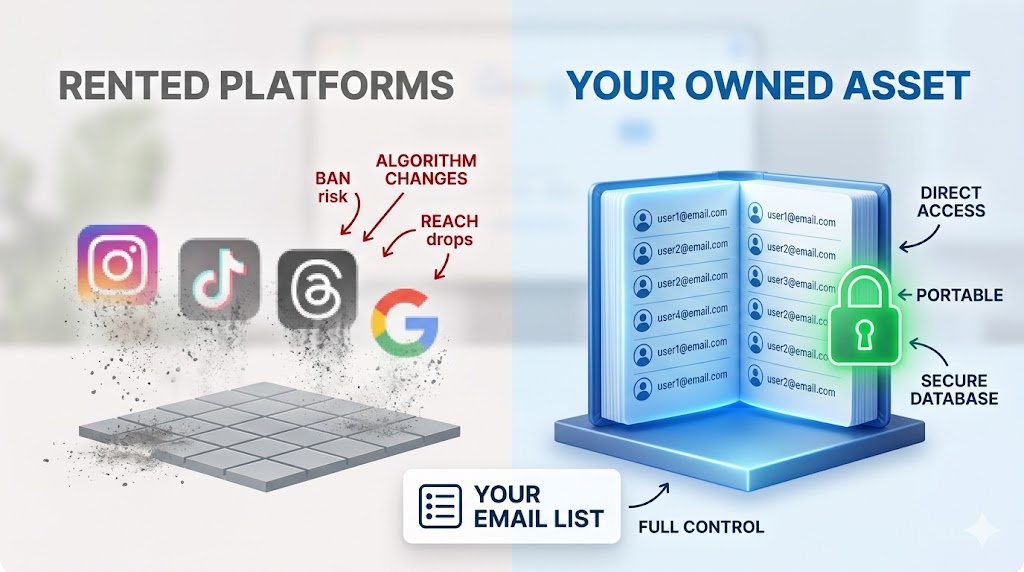
But you do not own any of it.
The platform owns the relationship. The platform decides who sees your content, how often, under what algorithm conditions. The platform can change those conditions at any time. It can reduce your organic reach to near zero overnight. It can suspend your account. It can shut down entirely.
When that happens — and for enough platforms, it eventually does — your following does not come with you. There is no export button. There is no way to reach those people directly. They are gone.
The same is true for search traffic. You can spend a year building a site to page one of Google for a high-volume keyword. A single algorithm update can bury it. Your traffic drops to nothing with no warning and no recourse.
Paid traffic is even more temporary. The moment your ad budget runs out, so does your traffic.
What makes an email list different
An email list is the one asset in online business that you actually own outright.
The relationship is direct. When you send an email, it goes to your subscriber’s inbox — not through a platform that decides whether your content gets seen. There is no algorithm between you and your audience.
The list is portable. You can export it as a spreadsheet and take it to any email platform you want. You are not locked in. Your list is yours regardless of what any company decides to do with their terms of service.
The list is permanent. Unless a subscriber actively unsubscribes, they remain on your list indefinitely. The subscribers you acquired two years ago are still there. Still reachable. Still potentially valuable.
And the list is scalable in a way that compounds. Every new subscriber adds to the base. Every email you send reaches the entire accumulated list — not just the people who happened to be online when you posted.
The economics of list ownership
The numbers on this are not complicated.
A well-maintained email list typically generates somewhere between one and three dollars per subscriber per month, depending on the niche and how well the list is monetised. That varies widely, but even at the conservative end, a list of a few thousand engaged subscribers represents a meaningful ongoing income.
More importantly, it represents an income that does not reset to zero every month based on your traffic. It accumulates. It builds. The work you did last year is still paying you this year.
That is what an owned asset looks like.
Building the list from day one
The catch is that you can only build a list if your system is set up to capture email addresses. If you are sending traffic directly to affiliate offers, no list gets built. Buyers end up on the vendor’s list. Non-buyers disappear.
Every visitor who lands on your offer without going through a squeeze page first is a permanent loss — someone who will never be on your list, never receive a follow-up, never become a long-term subscriber.
The fix is a capture-first model. And it does not require building anything from scratch.